7 Signs Your Concrete Needs Professional Leveling
Spot the warning signs of sinking concrete before costly damage occurs. Learn 7 indicators that your Colorado Springs property needs leveling.
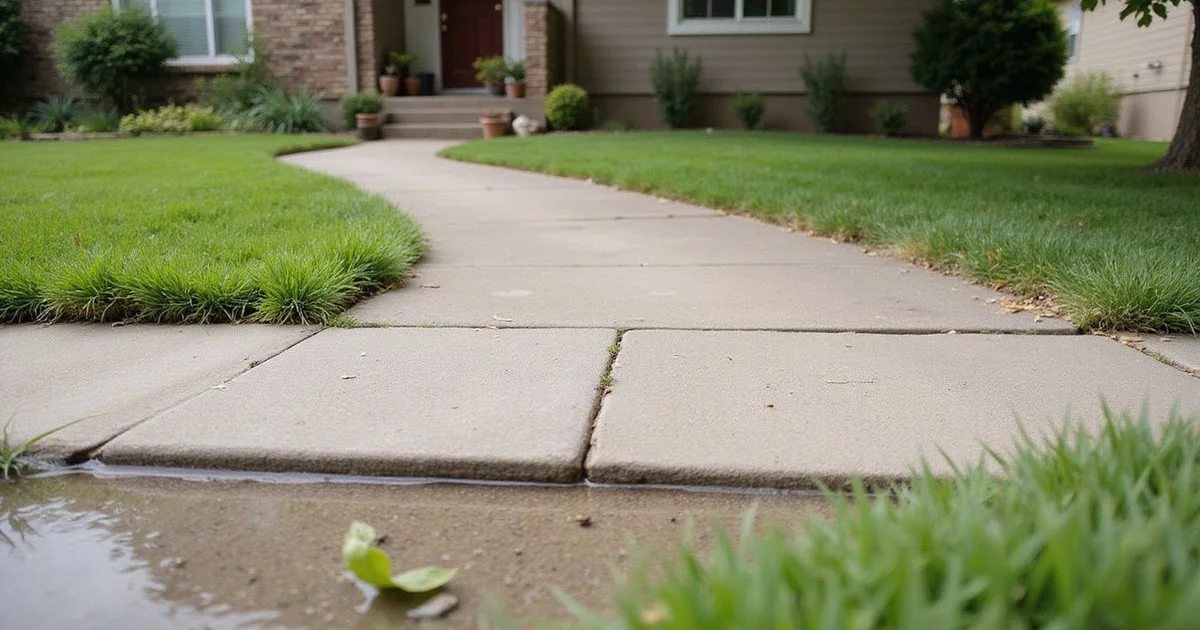
Concrete does not sink overnight. It settles gradually, and by the time most homeowners notice the problem, the damage has been progressing for months or even years.
In Colorado Springs, where expansive clay soils—specifically the notorious Pierre Shale—and dramatic freeze-thaw cycles put constant stress on concrete, catching the early signs of settling can save you from expensive full replacement. We see this daily, where a small gap in April becomes a major trip hazard by October.
From what I’ve seen, the difference between a simple repair and a full tear-out often comes down to recognizing the subtle warning signs before they escalate.
Let’s look at the specific indicators our team watches for, the data behind why they happen, and the practical steps you can take to protect your home.
1. Water Pooling on Flat Surfaces
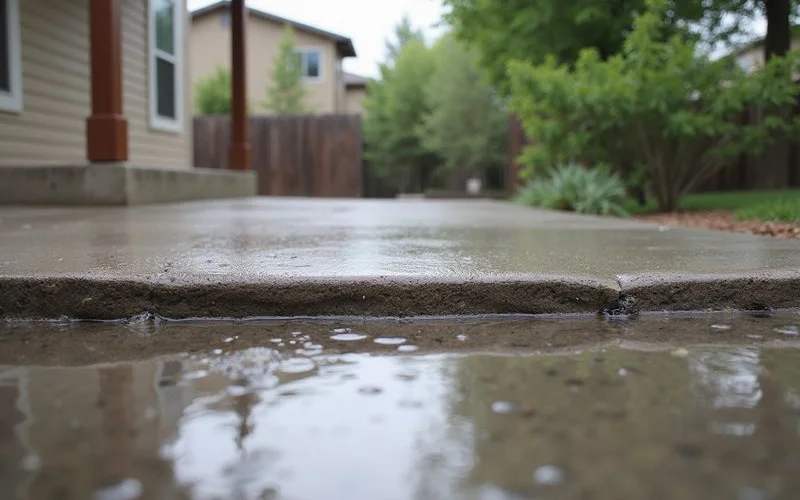
This is often the first noticeable sign. After a rain shower or snowmelt, you see puddles that linger on your driveway, patio, or sidewalk.
Concrete is poured level for a reason, and standing water means the slab has shifted.
Why it matters in Colorado Springs: Our region typically receives between 15 and 25 inches of precipitation annually, with significant spring snowmelt. Water that pools on concrete seeps into cracks and beneath slabs.
When temperatures drop below freezing—which happens frequently given our high-altitude climate—that trapped water expands and accelerates the settling cycle.
If you notice water consistently collecting in the same spots on your concrete, it is time to get an assessment.
The “Birdbath” Warning
Industry professionals often refer to these small, lingering puddles as “birdbaths.” While they might seem harmless, they indicate a deviation from the standard slope requirements.
The Pikes Peak Regional Building Code aligns with International Building Code (IBC) standards, generally recommending a minimum slope of 2% (about 1/4 inch per foot) for paved surfaces to ensure proper drainage.
Our team looks for these specific deviations during an assessment because they almost always point to a void forming underneath the slab. Addressing this early prevents the water from turning a minor dip into a major crack.
Pro Tip: The “Hose Test” If you aren’t sure if a low spot is serious, spray water on the area on a dry day. If the puddle remains after 15-20 minutes while the surrounding concrete is dry, you likely have a drainage issue that is actively undermining your slab.
2. Visible Gaps Between Slabs and Structures
Look at where your driveway meets the garage floor, where your patio meets the house foundation, or where your sidewalk meets the front steps. A gap of half an inch or more indicates the slab has dropped away from the fixed structure.
These gaps are more than cosmetic. They allow water, debris, and pests to enter beneath the slab, which worsens the underlying void and speeds up further settling.
In Colorado, these gaps also let snowmelt flow directly beneath your foundation, which can create much bigger problems.
The “Bridge” Effect
When soil settles beneath a slab, the concrete briefly acts like a bridge, spanning the empty space without support. Eventually, the weight of a vehicle or even foot traffic will snap that bridge.
We often use a simple “sounding” technique—tapping the concrete with a hammer or dragging a heavy chain across it—to hear the hollow sound that indicates a hidden void before the slab actually breaks.
Filling these voids with our limestone slurry stabilizes the slab immediately. This preventative step is significantly cheaper than waiting for the concrete to crack and require removal.
Maintenance Insight: After leveling, we always recommend sealing these joints with a high-quality polyurethane self-leveling sealant. Unlike rigid mortar, polyurethane remains flexible during our temperature swings, keeping the seal watertight year-round.
3. Trip Hazards at Slab Joints
When adjacent concrete slabs settle at different rates, the joints between them become uneven. A lip of even a quarter inch can be a trip hazard, and once the difference reaches half an inch, it becomes a genuine safety and liability concern.
Common locations for trip hazards include:
- Sidewalk sections near mature trees (root growth displaces soil)
- Driveway expansion joints
- Patio transitions to walkways
- Pool deck sections
If someone trips and falls on your property due to uneven concrete, you could face a liability claim. Fixing the issue proactively is always the smarter choice.
The 1/4-Inch Rule and Liability Risks
The Americans with Disabilities Act (ADA) defines a trip hazard as any vertical change in level of 1/4 inch or more. While private residences aren’t always strictly bound by ADA codes, personal injury lawyers often use these standards to establish negligence in court.
We see this frequently with delivery drivers or guests. Recent data indicates that the average settlement for a residential slip-and-fall claim in Colorado typically ranges between $15,000 and $75,000 depending on injury severity.
Leveling a walkway often costs a fraction of a potential insurance deductible or legal settlement.
4. Doors or Windows That Stick or Do Not Close Properly
This sign surprises many homeowners, but it makes sense when you think about it. When concrete around your foundation settles unevenly, it can put asymmetric pressure on the structure itself.
Interior doors that used to close smoothly may start sticking. Windows may become difficult to open or close.
While sticking doors can have other causes (humidity changes, foundation issues), if you notice this symptom alongside any other signs on this list, uneven concrete could be a contributing factor.
Understanding Differential Settlement
The real enemy here is “differential settlement,” which happens when one part of the foundation sinks faster than another. This twists the home’s frame, distorting door jambs and window tracks.
Our technicians check for this by looking for diagonal cracks coming off the corners of door frames, often at a 45-degree angle. If the exterior concrete is pulling away from the foundation while doors inside are sticking, the issue might be localized to the soil directly abutting the house.
Catching this early prevents the stress from transferring further up the walls and into the roof structure.
5. Cracks That Are Growing or Spreading
Not all concrete cracks are cause for alarm. Hairline cracks from normal curing and shrinkage are common.
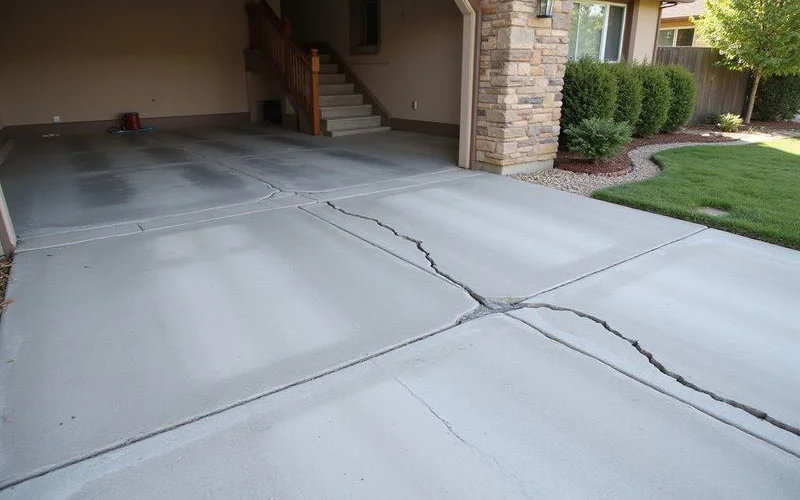
However, cracks that are widening, lengthening, or multiplying indicate active movement beneath the slab.
Warning signs include:
- Cracks wider than a quarter inch
- Cracks that are wider at one end than the other (indicating tilting)
- New cracks appearing alongside existing ones
- Cracks that run across the full width of a slab
In Colorado Springs, the combination of our bentonite clay soils and freeze-thaw cycles means that once cracking starts due to settling, it typically accelerates without intervention.
The Nickel Test
A simple way to gauge the severity of a crack is the “Nickel Test.” If you can fit a nickel into the crack (which is roughly 2mm or just under 1/8 inch thick), it is wide enough to allow significant water intrusion.
We recommend sealing these cracks immediately after leveling. Water entering a crack during a Colorado winter will freeze and expand with 2,000 to 3,000 psi of pressure, which is enough to break even the strongest concrete.
6. Your Concrete Is Less Than 15 Years Old but Already Uneven
Quality concrete, properly poured on well-prepared soil, should last 25 to 30 years before needing major work. If your slabs are noticeably uneven after just 5 to 15 years, it points to soil issues beneath the surface rather than material failure.
This is particularly common in newer Colorado Springs developments built on previously undeveloped land. The soil may not have been adequately compacted before pouring, or the natural clay content creates ongoing shrink-swell cycles that disturb the slab.
The good news: leveling concrete that is structurally sound (no major spalling or deep deterioration) is straightforward and far less expensive than full replacement. If your concrete is in decent shape but just uneven, leveling is almost certainly the right solution.
The Critical “Settlement Window”
Most major settling occurs within the first 5 to 7 years after construction as the backfill soil compresses. This is often due to the soil not achieving the industry-standard 95% Proctor density during the initial build.
Our experience shows that if you level the concrete after this initial settling period, the repair is often permanent. The soil has finished compacting, and our limestone slurry provides a stable, non-erodible base that locks the slab in place.
| Feature | Concrete Leveling (Mudjacking) | Full Concrete Replacement |
|---|---|---|
| Average Cost (2026) | $3 - $6 per sq. ft. | $12 - $20+ per sq. ft. |
| Time to Complete | 1 Day | 3 - 5 Days (plus curing time) |
| Use After Repair | Immediate (or within hours) | 7 - 10 Days |
| Mess / Disruption | Minimal (drilling small holes) | High (demolition & pouring) |
7. You Can See Daylight Beneath the Slab Edges
Get down low and look along the edges of your concrete slabs, especially where they meet landscaping, curbs, or other surfaces. If you can see gaps or daylight beneath the slab edge, voids have formed underneath.
Voids beneath concrete are the root cause of settling. They form when:
- Water washes out soil (erosion from poor drainage)
- Clay soils shrink during dry periods
- Organic material beneath the slab decomposes
- Tree roots decay after removal
Once voids form, the slab above is essentially a bridge spanning empty space. Eventually, the weight of the concrete and any loads on top (vehicles, foot traffic) will cause the slab to crack and drop into the void.
Identifying “Piping” and Erosion
Civil engineers refer to the internal erosion of soil as “piping,” where water creates a tunnel underneath your concrete. If you see a void that reappears even after you’ve tried to pack dirt into it, you likely have active piping caused by drainage issues.
We address this by not just filling the void, but helping you identify the drainage issue causing it. Often, simply extending your downspouts at least 5 to 10 feet away from the concrete edge can stop the erosion cycle permanently.
What to Do If You Spot These Signs
If you recognize one or more of these warning signs on your property, the most important step is getting a professional assessment before the problem worsens. Concrete leveling with limestone slurry is significantly less expensive than full slab replacement, typically costing 50 to 70 percent less.
At Colorado Springs Leveling, we provide free on-site evaluations. We measure the extent of settling, assess soil conditions, and give you an honest recommendation.
Not every slab needs leveling; sometimes simple crack sealing or surface protection is enough. But when leveling is needed, our limestone slurry method provides a durable, long-lasting solution backed by our 2-year warranty.
Learn more about our driveway leveling services or contact us to schedule your free assessment. Catching these problems early can save you thousands in future repair costs.