Mudjacking vs Foam vs Limestone Slurry: Which Is Best?
Compare mudjacking, polyurethane foam, and limestone slurry concrete leveling methods. Learn which works best for Colorado Springs properties.
If you’re staring at a sunken driveway or a sidewalk trip hazard in Colorado Springs, you’ve likely realized that ignoring it isn’t an option. You might be worried about a potential lawsuit, or maybe you just received a notice from your HOA. The good news is that you don’t always need to tear it out and start over.
You have likely come across three main repair options: traditional mudjacking, polyurethane foam injection, and limestone slurry leveling.
From what we’ve seen in the field, the difference between a fix that lasts two years and one that lasts twenty often comes down to matching the material to our unique soil conditions. Each method has its place, but understanding the differences can save you thousands of dollars and years of frustration. After completing over 20,000 concrete leveling jobs across the Pikes Peak region, we have seen firsthand how each method performs in our climate.
What Is Mudjacking?
Mudjacking (also called slabjacking) is the oldest method of concrete leveling. A mixture of water, soil, sand, and cement is pumped through 1.5 to 2-inch holes drilled into the sunken slab. The hydraulic pressure lifts the concrete back to its original position.
While it is a proven method, it relies heavily on the contractor’s “recipe” for the mud mixture. Some use high-quality cement blends, while others use cheaper, dirt-heavy mixes that wash away easily.
Pros of Mudjacking:
- Lowest upfront cost: Typically runs $3 to $7 per square foot, making it the budget-friendly choice.
- High compressive strength: When mixed correctly with cement, it can reach compressive strengths of up to 2,400 PSI (Pounds Per Square Inch).
- Widely available: Most local general contractors offer this service.
- Natural materials: The mixture is primarily earth-based.
Cons of Mudjacking:
- Heavy material weight: The mixture weighs 100 to 150 pounds per cubic foot. This adds significant load to the soil, which can cause re-settling.
- Large, visible drill holes: The injection holes are 1.5 to 2 inches in diameter—roughly the size of a soda can top—which are hard to hide even after patching.
- Susceptible to erosion: The mud mixture is porous. In our wet spring seasons, water can seep in and wash the supporting material away.
- Shorter lifespan: We typically see these repairs last 3 to 5 years in Colorado conditions before needing attention again.
The biggest concern with traditional mudjacking in Colorado Springs is the weight factor. Our expansive clay soils already shift under load, and adding heavy mud slurry beneath a slab can accelerate the settling process over time.
What Is Polyurethane Foam Injection?
Foam jacking uses high-density polyurethane foam injected through much smaller holes. It is a newer technology that has gained popularity over the last decade for its speed and minimal invasiveness.
The process involves a chemical reaction between two liquid components (isocyanates and polyols) that expand rapidly once injected, filling voids and lifting the concrete.
Pros of Foam Jacking:
- Extremely lightweight: The material weighs only 2 to 4 pounds per cubic foot, putting almost no additional stress on the underlying soil.
- Tiny injection holes: Holes are approximately 5/8 inch (about the size of a dime), making them nearly invisible once patched.
- Immediate use: The foam cures in about 15 minutes, meaning you can park your car on the driveway almost immediately.
- Waterproof: The closed-cell structure resists water and will not wash away.
Cons of Foam Jacking:
- Most expensive option: Expect to pay $5 to $11 per square foot due to the high cost of the chemical materials.
- Lower compressive strength: Consistently tests around 80 to 100 PSI. While sufficient for residential slabs, it lacks the rock-hard density of cement-based options.
- Environmental concerns: It is made from petroleum-based chemicals and is not biodegradable.
- Difficult to control: The rapid expansion can sometimes over-lift a slab if the technician is not extremely precise.
What Is Limestone Slurry Leveling?
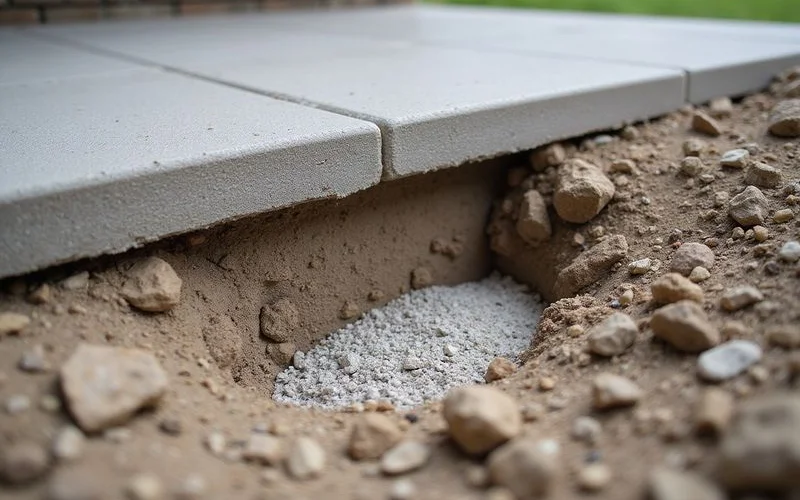
Limestone slurry leveling represents a strategic middle ground. A precisely engineered mixture of crusite limestone and cement is pumped through small holes beneath the sunken slab.
This material is denser than foam but offers better flow and stability than traditional mudjacking compounds. It cures to a compressive strength that rivals the surrounding soil, creating a stable, long-term base.
Pros of Limestone Slurry:
- Stability against frost heave: At roughly 100 to 120 pounds per cubic foot, the material provides enough mass to resist shifting during freeze-thaw cycles without being as excessively heavy as crude mud mixtures.
- Superior void filling: The slurry flows more easily than thick mud, filling small gaps and supporting the entire slab evenly.
- Environmentally friendly: It uses natural crusite limestone and cement, avoiding the petroleum chemicals found in foam.
- Extended lifespan: We see typical lifespans of 8 to 15 years, significantly outlasting traditional mudjacking.
- Cost-effective: Typically costs $4 to $8 per square foot, bridging the gap between cheap mudjacking and expensive foam.
Cons of Limestone Slurry:
- Longer curing time: Requires 24 to 48 hours to reach full strength before you can drive on it.
- Availability: It is a specialized service and not as widely available as general mudjacking.
Why Colorado Springs Conditions Matter
Living at over 6,000 feet of elevation, our region faces unique challenges that directly affect concrete leveling performance. You cannot simply use the same methods here that work in Florida or Texas.
The Freeze-Thaw Reality
Colorado Springs experiences rapid temperature swings, often fluctuating 40 degrees or more in a single day. This creates a brutal freeze-thaw cycle. Water that seeps beneath slabs freezes, expands, and then thaws, creating voids.
Traditional porous mudjacking material absorbs this moisture and crumbles. Limestone slurry is denser and resists water penetration far more effectively, maintaining its integrity through our winter swings.
The Bentonite Clay Problem
El Paso County is known for its expansive bentonite clay soils. These soils swell significantly when wet and shrink when dry, creating constant ground movement.
A leveling material that is too heavy (like traditional mud) puts additional stress on this already unstable soil, causing it to sink further. Limestone slurry strikes the right balance—heavy enough to provide a stable base that resists frost heave, but engineered to distribute the load evenly.
Altitude and Curing
Low humidity and high altitude affect curing chemistry. Polyurethane foam can behave unpredictably in our dry, high-altitude environment, sometimes expanding more or less than expected. Limestone slurry curing is a chemical reaction with the cement that remains predictable and consistent at elevation.
Head-to-Head Comparison
| Factor | Mudjacking | Foam | Limestone Slurry |
|---|---|---|---|
| Cost per sq ft | $3 - $7 | $5 - $11 | $4 - $8 |
| Compressive Strength | Up to 2,400 PSI | 80 - 100 PSI | High (Rivals Concrete) |
| Material Weight | ~140 lbs/cu ft | 2-4 lbs/cu ft | ~100-120 lbs/cu ft |
| Drill Hole Size | 1.5 - 2 in (Soda Can) | 5/8 in (Dime) | 1 in (Quarter) |
| Cure Time | 24 - 72 Hours | 15 Minutes | 24 - 48 Hours |
| Lifespan | 3 - 5 years | 5 - 8 years | 8 - 15 years |
| Eco-friendly | Moderate | Poor | Excellent |
Our Recommendation
After leveling concrete across Colorado Springs for years and completing over 20,000 jobs, we consistently see the best long-term results with limestone slurry. It offers the durability and strength that our local conditions demand, without the excessive cost of foam or the short lifespan of traditional mudjacking.
That said, every project is different. Small interior slabs like garage floors might be fine candidates for foam because of the quick cure time. Budget-conscious repairs on non-critical walkways could work with mudjacking if you accept the shorter lifespan. The right answer depends on your specific situation.
Get a Free Assessment
Not sure which method is right for your property? We offer free on-site assessments where we evaluate your soil conditions, slab thickness, and the extent of settling.
We will verify if your settling is caused by simple soil compaction or active bentonite clay movement. Learn more about our driveway leveling services or give us a call to schedule your inspection. Every project we complete comes with our 2-year warranty, so you can have confidence in the results.