Can You Level Concrete in Winter? A Colorado Guide
Find out if concrete leveling works in Colorado winters. Learn why limestone slurry performs well in cold weather and when to schedule repairs.
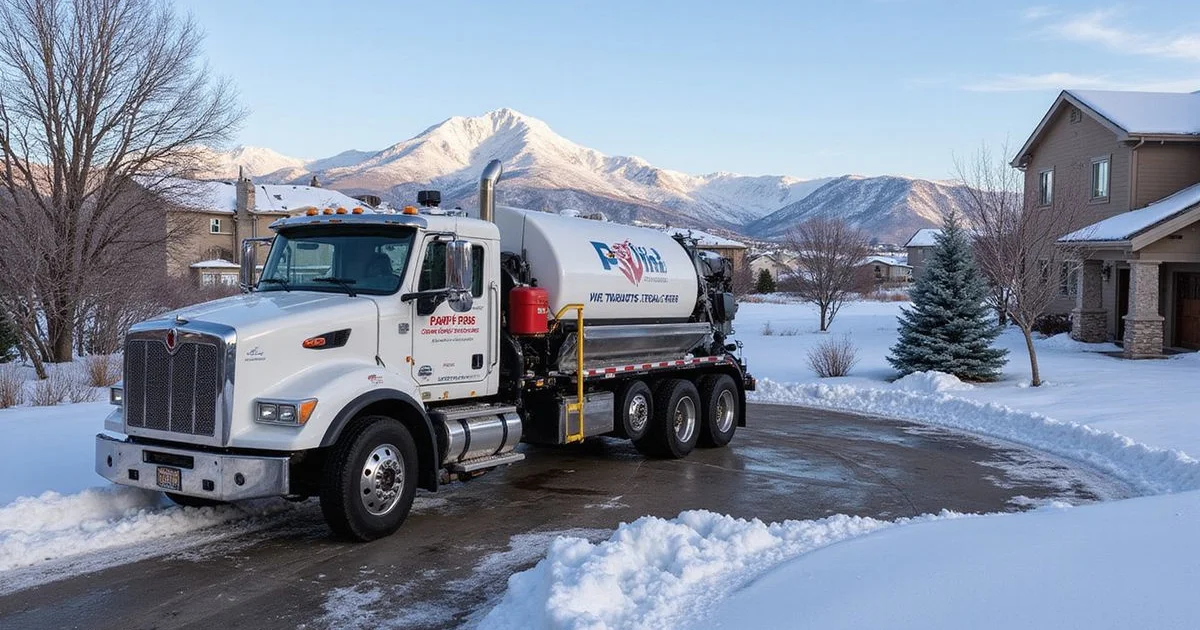
You probably think concrete repair is strictly a summer job.
It’s a reasonable assumption, especially when you see the frost collecting on Pikes Peak.
We hear this concern from homeowners every single week between November and March.
The common logic suggests waiting until May to fix a sinking slab, but that delay often leads to further settling during the freeze-thaw cycles.
Our experience in the Pikes Peak region tells a different story.
Colorado Springs sees specific winter weather windows where leveling is not just possible, but often more effective than waiting for the spring thaw.
Let’s look at the data, the specific chemistry required for the cold, and why addressing this now prevents more expensive damage later.
The Short Answer: Yes, But the Material Matters
Concrete leveling in winter is absolutely viable if you use a method engineered for thermal stability.
We rely exclusively on a limestone slurry specifically modified for cold-weather application.
This material succeeds because it generates its own internal heat, creating a dense, self-warming structure that cures despite freezing air temperatures.
Unlike water-heavy mudjacking that risks freezing or chemical foams that struggle to react in the cold, limestone slurry provides a predictable, consistent cure.
A calcium-rich mix with rapid-set properties is the only way to guarantee stability when the ground temperature drops.
Why Traditional Methods Struggle in Winter
The Physics of Mudjacking in Cold Weather
Traditional mudjacking pumps a mixture of topsoil, sand, and significant amounts of water under your slab.
That water content becomes a liability the moment the thermometer drops below 32°F.
- The Expansion Factor: Water expands by approximately 9% when it turns to ice. If the slurry freezes before it cures, it lifts the slab unevenly.
- Shrinkage Voids: Once that ice thaws in spring, it leaves behind air pockets that cause the concrete to settle again.
- Equipment Failures: Hydraulic lines often freeze when transporting wet soil mixtures, leading to incomplete lifts.
Most mudjacking operations in El Paso County shut down from late November through March to avoid these specific risks.
The Chemistry of Foam Injection
Polyurethane foam is an excellent product for many applications, but it is chemically sensitive to low temperatures.
These two-part chemical systems require specific heat thresholds to react and expand properly.
- Reaction Shock: Foam chemicals typically require an ambient temperature between 70°F and 90°F to function correctly. Hitting frozen ground at 30°F can shock the chemicals, stunting the reaction.
- The Heat Sink Effect: Frozen ground acts as a heat sink, stealing the energy the foam needs to expand. This often results in a denser, more expensive product usage or an incomplete lift.
- Manufacturer Limits: Many foam manufacturers advise against application when surface temperatures fall below 40°F, as the cured product may become brittle or fail to adhere to the sub-base.
Why Limestone Slurry Works in Winter
We choose limestone slurry for winter work because it relies on an internal chemical reaction rather than air temperature to cure.
This process involves specific material science that actually favors cold-weather application.
1. Utilizing Type III “High Early” Cement
For winter projects, we modify our mix design to use Type III Portland cement.
This variety is ground much finer than standard cement, which significantly accelerates the hydration process.
The result is a set time that is often 50% faster than standard mixes.
Rapid hardening ensures the material achieves structural strength before the cold can affect its integrity.
2. The Exothermic Advantage
When this specific cement hydrates, it generates a substantial amount of internal heat.
Type III cement can generate approximately 88 calories of heat per gram during hydration.
This exothermic reaction warms the slurry from the inside out.
Even if the ground is 35 degrees, the material itself acts as a thermal battery, maintaining the necessary temperature to cure hard and fast.
3. Lower Water-to-Solids Ratio
Our limestone slurry uses a low-water mix that is dense and calcium-rich.
Minimal free water availability eliminates the risk of the material freezing before it sets.
This allows us to work safely in ambient temperatures that would freeze a traditional mudjacking mix solid.
Comparison: Winter Leveling Methods
| Feature | Limestone Slurry | Traditional Mudjacking | Polyurethane Foam |
|---|---|---|---|
| Material Base | Crushed Limestone & Cement | Soil, Sand & Water | Chemical Polymers |
| Winter Additive | Type III High-Early Cement | Calcium Chloride (Corrosion Risk) | Heated Hoses Only |
| Min. Install Temp | 25°F (and rising) | 32°F+ | 40°F+ (Manufacturer Spec) |
| Heat Generation | High (Exothermic) | None | Low |
| Frost Heave Risk | Low (Dense Fill) | Critical (Ice Expansion) | Low |
| Cure Time to Traffic | 2-4 Hours | 24-48 Hours | 15-30 Minutes |
Our Winter Protocol
We adhere to a rigorous cold-weather standard operating procedure (SOP) to ensure every winter repair is permanent.
Safety and durability remain our top priorities during these months.
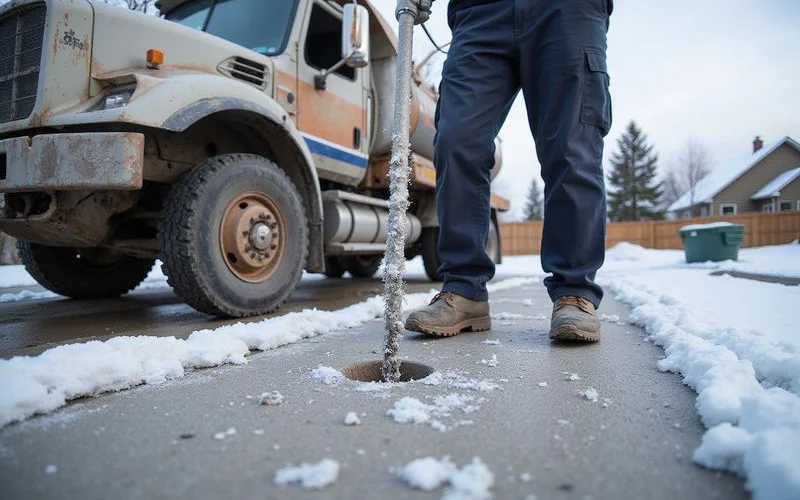
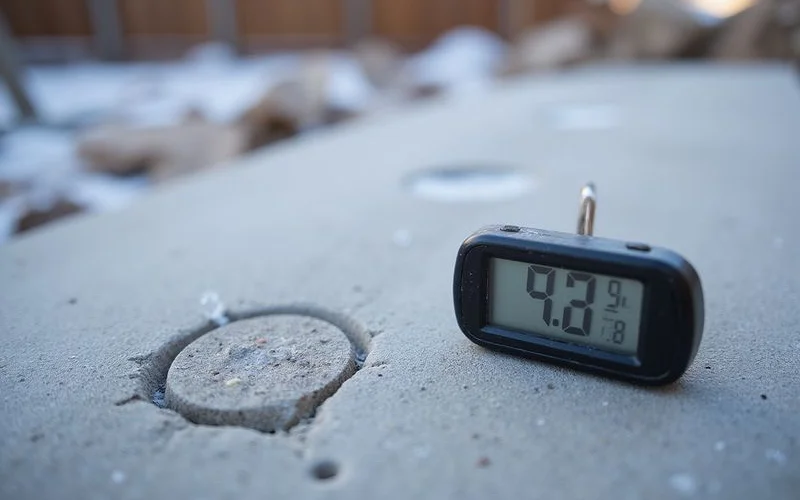
- Infrared Surface Verification: We use industrial FLIR infrared thermometers to scan the surface and ground temperatures. This data tells us immediately if the sub-slab soil is below our safety threshold.
- Climate-Controlled Transport: Our material travels in heated trailers to maintain an optimal mix temperature right up to the moment of injection.
- Rapid-Cure Adjustments: On colder days, we increase the cement concentration. This boosts the heat of hydration to ensure a rapid set.
- Insulated Curing Blankets: Immediately after injection, we cover critical areas with R-7.7 insulated curing blankets. These heavy-duty thermal covers trap ground heat and the slurry’s internal heat to guarantee a proper cure.
- Post-Cure Verification: We return to inspect the lift and ensure the patches have sealed correctly against moisture.
When Winter Leveling Makes Sense
Colorado Springs averages over 240 sunny days per year.
Many of those clear days occur in December and January, providing excellent working conditions.
We look for specific “Goldilocks” windows to perform this work effectively.
The “Go” Criteria:
- Solar Gain: Full sun exposure on the driveway can raise the concrete surface temperature 10-15 degrees higher than the air temperature.
- Temperature Trend: A forecast of 25°F and rising during the work window gives us the thermal margin we need.
- Dry Conditions: Active snowmelt running into the drill holes is a dealbreaker, so dry surfaces are mandatory.
The “No-Go” Criteria:
- Deep Frost: If the ground is frozen solid below the 30-inch frost line common in El Paso County, we pause operations.
- Active Storms: Any accumulation of snow over 2 inches or active precipitation stops work immediately.
- North-Facing Shade: Driveways that receive zero direct sunlight in winter may stay too cold for optimal results.
Why Not Just Wait Until Spring?
You might be thinking it is easier to just wait until May.
While that is a valid choice, specific local data points suggest tackling this sooner is better.
1. Spring is Actually the Wettest Season
March is historically one of the snowiest months in Colorado Springs, averaging 5.7 inches of snow.
NOAA data shows that April follows closely behind with an average of 4.9 inches.
Waiting until spring means scheduling your repair during the wettest, muddiest time of the year.
Winter work often enjoys drier, clearer weather patterns that are better for concrete stability.
2. Stopping the Freeze-Thaw Cycle
Water that pools in sunken areas will freeze and expand at night.
This expansion pushes the slab up, only to drop it again when the ice thaws the next morning.
This “frost heave” action destabilizes the sub-base and widens existing cracks.
Fixing the grade now prevents months of this destructive cycle from causing further damage.
3. Avoiding the “Spring Rush” Premium
Spring is when the entire construction industry wakes up.
Lead times can stretch to 6-8 weeks once the warmer weather stabilizes.
By scheduling in winter, you often secure faster service and more flexibility with dates.
Our Track Record in Winter
We have successfully leveled thousands of square feet of concrete during the winter months using this specialized limestone method.
Our experience confirms that the right mix and protection make winter repairs just as durable as summer ones.
Every winter project comes with the same 2-year warranty we offer year-round.
Schedule Your Winter Assessment
Don’t let a tripping hazard sit under the snow all winter.
Check out our full range of driveway leveling services and reach out for a consultation. Winter is also an excellent time for garage floor leveling since the enclosed space provides natural temperature protection.
We will give you an honest “Go/No-Go” assessment based on your specific sun exposure and soil conditions.
Getting a professional eye on your concrete now can save you from a more expensive replacement later.